


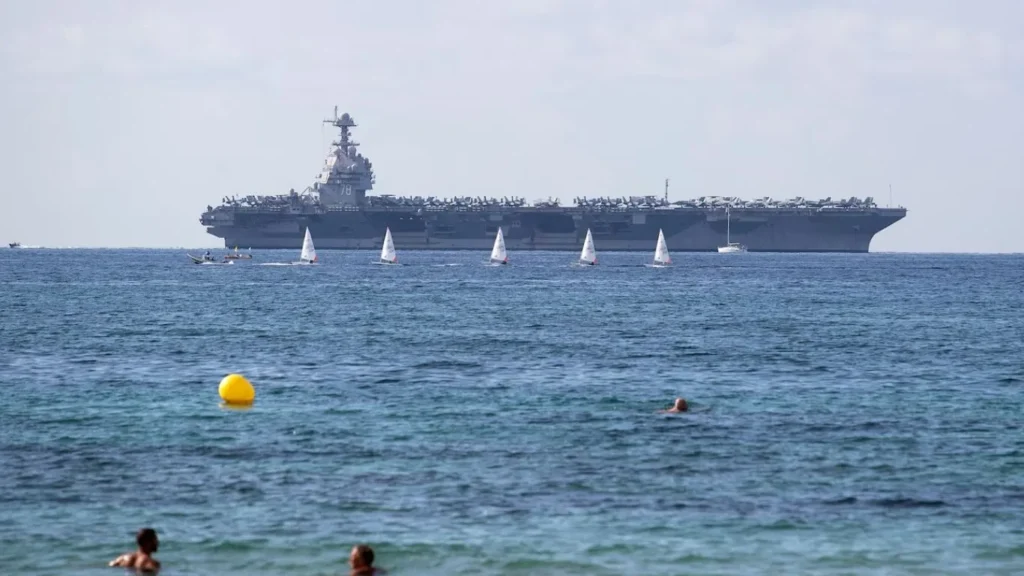
Tensions are rising in the Western Hemisphere after the Pentagon ordered the USS Gerald R. Ford aircraft carrier strike group to deploy to Latin America, marking one of the most significant U.S. military moves in the region in decades. The decision, directed by President Donald Trump, signals a potential escalation of American involvement under the banner of “counter-narcotics operations,” though analysts warn it could have far broader implications.
Overview of the Deployment
According to the U.S. Department of Defense, the carrier group’s movement toward Latin American waters aims to target transnational criminal organizations (TCOs) and drug-trafficking networks. However, the scale and timing of the deployment suggest a more assertive show of power that could reshape regional geopolitics.
Officials have confirmed that the strike group includes eight warships, F-35 fighter jets, and nearly 6,000 personnel—making it one of the largest maritime operations in the region since the early 2000s.
The Pentagon’s Official Statement
In a statement, Defense Secretary Pete Hegseth emphasized that the move is part of the Trump administration’s renewed effort to “disrupt and dismantle criminal organizations that threaten U.S. security and sovereignty.”
He described the deployment as a “proactive measure” against “illicit actors” operating across the Caribbean and South American corridors, which have long been key routes for narcotics and arms trafficking.
The USS Gerald R. Ford Strike Group Explained
Composition of the Fleet
The USS Gerald R. Ford, the world’s most advanced aircraft carrier, leads the operation. It’s accompanied by destroyers, cruisers, and a logistical support ship. This powerful armada represents a full-spectrum military force capable of executing air, sea, and intelligence operations simultaneously.
Mission Capabilities
The strike group brings state-of-the-art surveillance systems, missile defense technology, and unmanned aerial assets—giving the U.S. unmatched operational reach in the hemisphere. The move sends a clear signal: Washington is ready to use hard power if necessary.
Why Latin America?
The Trump administration has framed the deployment as a counter-narcotics campaign. However, experts suggest the strategic location of the deployment—close to Venezuelan and Colombian waters—indicates deeper political motivations.
The region has seen increased instability, and U.S. officials accuse several Latin American governments of turning a blind eye to drug cartels and foreign (notably Chinese and Russian) influence.
Trump’s Rationale for Escalation

Counter-Narcotics Operation
President Trump announced the initiative as part of a “new phase” in combating drug smuggling. He stated, “For too long, the U.S. has tolerated the poisoning of our citizens. Those days are over.”
Pressure on Venezuela and Regional Powers
Analysts, however, note that the move also serves as a strategic warning to Venezuela’s President Nicolás Maduro, whose regime has faced U.S. sanctions and accusations of harboring criminal networks. The deployment places U.S. naval power directly within striking distance of Caracas, intensifying diplomatic pressure.
Geopolitical Implications
Reaction from Latin American Nations
Latin American governments are responding cautiously. While U.S. allies like Colombia and Brazil expressed support, others, including Mexico, Venezuela, and Cuba, condemned the move as “military intimidation.”
Some fear this could revive Cold War–style tensions between the U.S. and its southern neighbors.
Response from Global Powers
Both Russia and China have criticized the deployment. Moscow warned of “consequences” if the U.S. uses force in sovereign waters, while Beijing called it an “unjustified show of aggression.” These reactions highlight how the situation could escalate into a broader international standoff.
Historical Context: U.S. Military Presence in Latin America
U.S. interventions in Latin America have a long and controversial history—from the Bay of Pigs invasion to Operation Condor and anti-narcotics efforts in the 1980s. Each campaign has left deep scars and lingering distrust.
The latest move revives old fears about American overreach and the militarization of diplomacy.
Strategic Importance of the Caribbean and South American Waters
Geographically, Latin American waters form a critical trade and defense zone. The Caribbean Sea and the Gulf of Mexico are gateways for global shipping lanes and energy routes. Control over these waters grants both strategic and economic leverage—a fact the Pentagon is keenly aware of.
Expert Opinions and Political Reactions
Defense analysts remain divided.
Some, like former General Robert Neller, argue that the operation “reasserts American dominance” and deters hostile actors. Others, including foreign policy scholar Dr. Laura Méndez, warn that the deployment risks “provoking unnecessary confrontation and undermining diplomatic efforts.”
In Congress, the move has sparked debate. Supporters in the Republican Party hail it as a “necessary act of deterrence,” while several Democrats have called for transparency and congressional oversight.
Possible Risks and Escalation Scenarios
Experts warn of potential flashpoints:
- Naval clashes with Venezuelan or allied forces.
- Civilian casualties if strikes occur near populated areas.
- Retaliatory cyber or proxy attacks from adversaries.
The U.S. has stressed that its mission is “strictly defensive,” but given the size of the fleet, regional actors may perceive it differently.

Economic and Diplomatic Fallout
The deployment could complicate trade relations and foreign investments across Latin America. Regional blocs such as MERCOSUR and CARICOM have expressed concerns about the impact on shipping lanes and commercial stability.
If the situation escalates, oil prices and regional currencies could fluctuate significantly.
Impact on Regional Stability
The presence of an American aircraft carrier in Latin American waters could either deter criminal networks or spark political instability. Local governments may find themselves under pressure to choose sides—either aligning with Washington’s policies or resisting what they see as interventionism.
Public and Media Reaction
Social media platforms have exploded with reactions. Hashtags like #USSFord, #TrumpDeployment, and #LatinAmericaTension are trending. Public opinion is divided—some view the move as decisive leadership, while others see it as reckless brinkmanship.
Conclusion
The Pentagon’s deployment of an aircraft carrier to Latin America under Trump’s directive is a powerful statement—one that mixes military might with political messaging. Whether it curbs crime or provokes confrontation remains to be seen. What’s certain is that this decision marks a new chapter in U.S.-Latin American relations, one that could redefine power dynamics across the hemisphere.
FAQs
1. Why did the U.S. deploy an aircraft carrier to Latin America?
To combat drug trafficking and transnational criminal organizations, according to official statements, though many analysts see broader strategic motives.
2. Which aircraft carrier was sent to the region?
The USS Gerald R. Ford, the U.S. Navy’s most advanced and powerful carrier.
3. Is this related to tensions with Venezuela?
Yes. The deployment positions U.S. forces closer to Venezuelan waters, increasing pressure on the Maduro regime.
4. How have Latin American nations responded?
Responses are mixed—some support the mission, while others denounce it as U.S. interference.
5. Could this lead to further military escalation?
It’s possible. While the U.S. insists the mission is defensive, the presence of such a large force could raise tensions or spark miscalculations.